How to Organise a Group Trip to Japan (for 8 or More People)
October 19, 2026
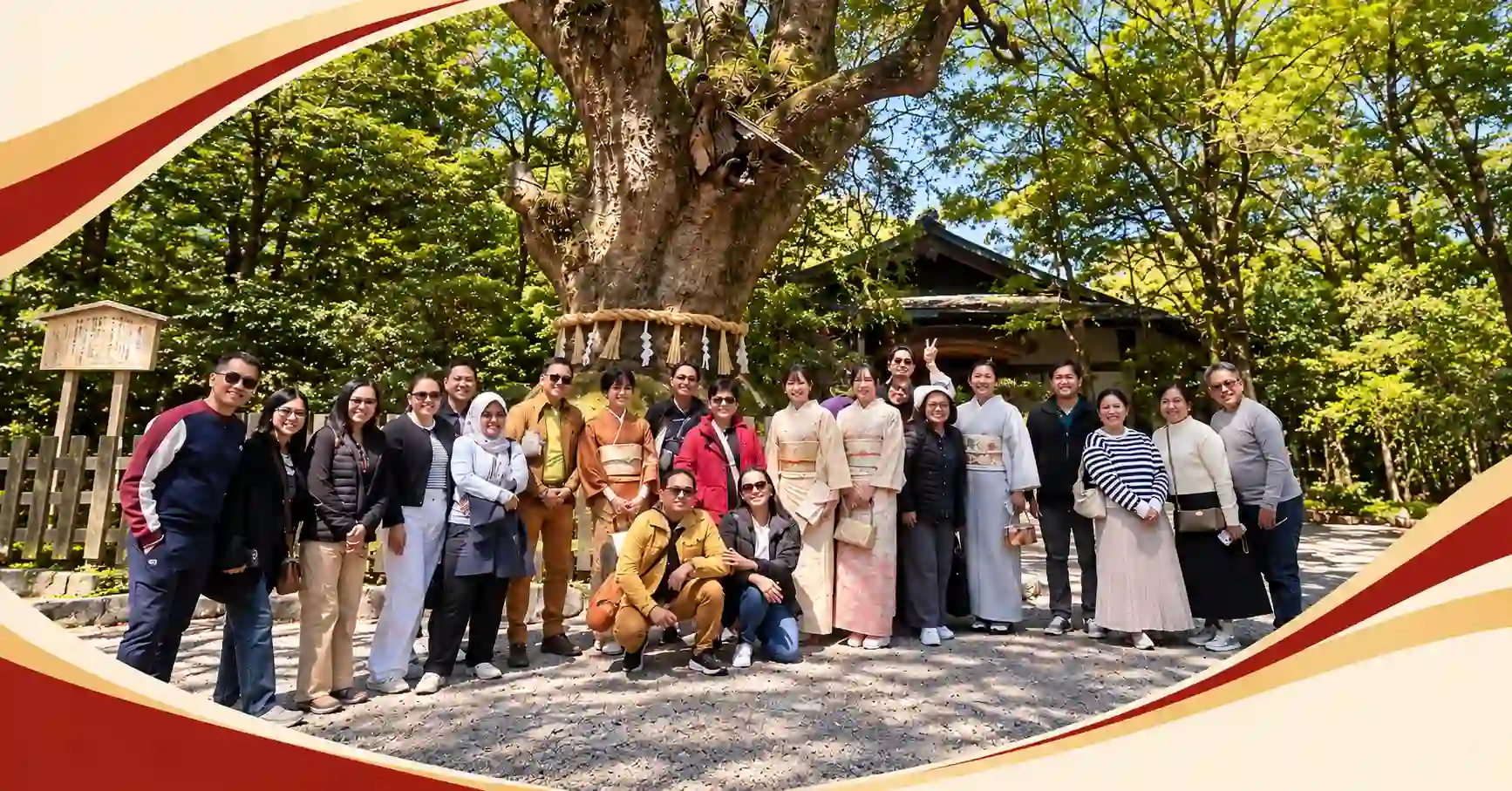
Twelve people. Twenty-four suitcases. A huge Tokyo station after a long flight from Australia, and an exit sign you’re pretty sure you’ve passed twice already. Your aunt needs a lift. The teenagers need Wi-Fi. Then someone near the ticket gates asks it: “So, where are we eating?”
Twelve opinions, one vegetarian, a restaurant with four free seats. Everyone looks at you.
How do you organise a group trip to Japan? Choose one decision-maker, agree dates and a budget in writing, and collect deposits before you book anything. Lock in flights and hotels early, because peak seasons fill first. For 8 or more people, decide whether you will run the daily logistics or hand them to a private guide.
This guide is for you, the one holding the clipboard. It follows the order the jobs land on your desk.
You, or you plus one deputy. Twelve people can share a holiday. They can’t share a steering wheel.
Group chats are where good trips go to stall. “Where should we go?” gets 40 replies and no answer. “Spring or autumn? Vote by Friday” gets an answer by Friday.
What helps:
Earlier than feels necessary, especially for cherry blossom season, school holidays and ski season.
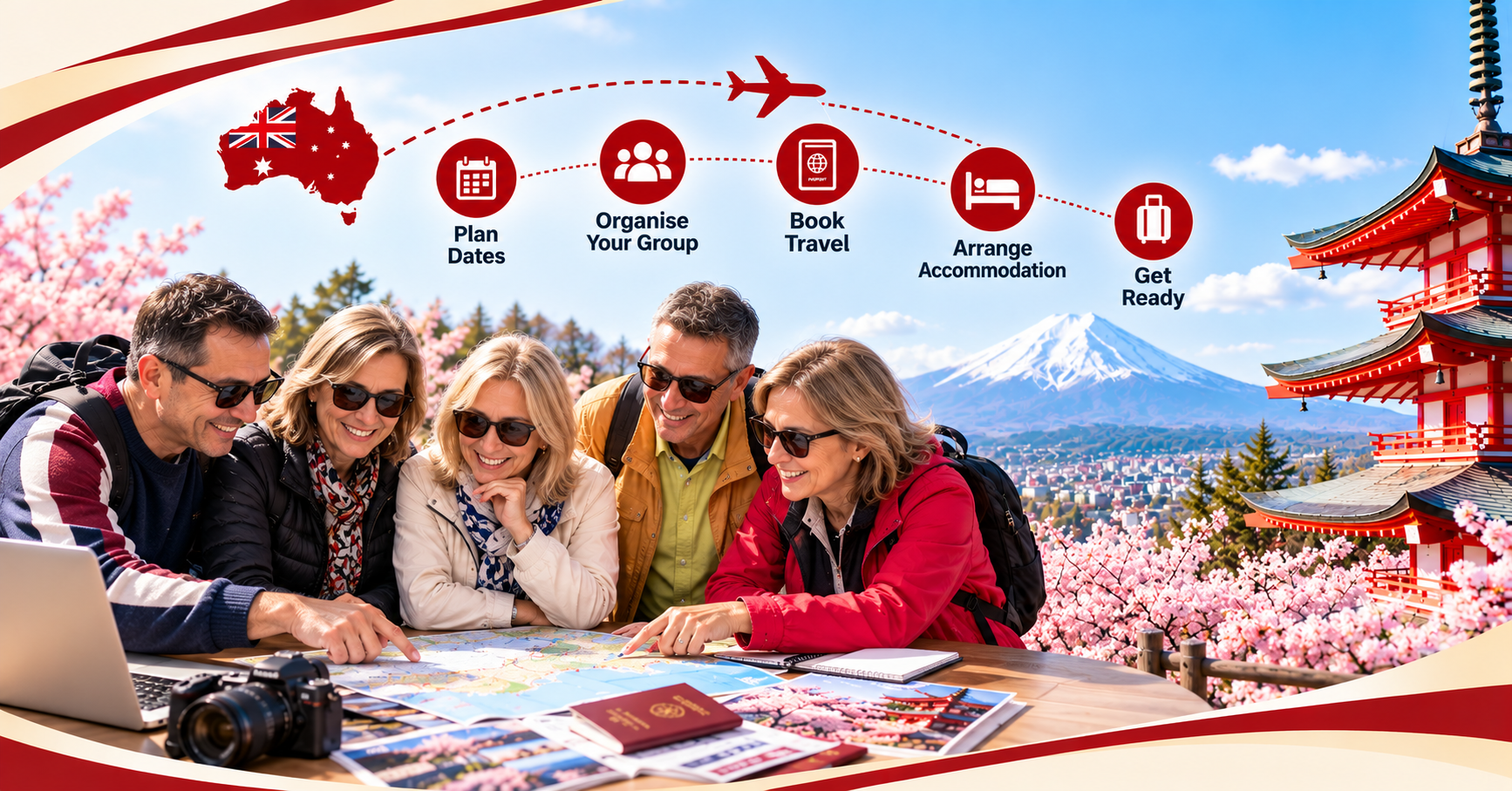
School holidays catch people first. Terms differ by state and shift each year, so cousins in Queensland and Victoria may overlap less than you’d think. Check every state’s calendar before anyone books leave.
Then flights. Our tours don’t include them, so each household books its own: into Tokyo and, on most itineraries, home from Osaka. Try to get everyone landing on the same day.
Last, the paperwork. Smartraveller’s Japan travel advice says Australians can visit Japan visa-free for stays under 90 days, and that Japan has strict rules on bringing in medication (checked 13 October 2026).
Anyone on regular medication should check before they pack.
Money can sour a group trip fast, and often over small amounts. Agree the rules before anyone pays a cent.
That’s planning advice, not financial advice. For your situation, talk to your insurer, your bank or a travel professional.
On our trips, each person can pay their own share. After the first part payment, you forward the confirmation email and everyone pays through its secure link. Full payment generally falls due two months after the deposit. Refunds depend on how far out someone cancels, and there are none inside three months of the tour start. Share the terms on our tour FAQ page early.
One catch: we price on twin share, so solo travellers pay more. Three people happy to share a triple room can ask us for a cheaper quote.
That depends on what you want to see, and how many crowds your oldest and youngest can handle. Our tours run in four windows:
Blossoms and autumn leaves keep their own schedule. We can’t guarantee peak colour on your dates, but we travel in the best seasonal windows. Plan around the season, not one perfect week.
More leave to play with? The 16-day Unforgettable Japan Tour adds Matsumoto, Takayama, Kanazawa, Hiroshima and Nara to the Tokyo to Osaka route.
The trains are brilliant. But 12 people and 24 bags on one train at once? Different story.
Start by measuring the suitcases. JR Central treats any bag up to 160 cm in total (length plus width plus depth) as normal luggage, roughly the size airlines check for free on international flights. Those go on the overhead racks or in the storage area near the doors, with no booking needed. It still takes teamwork to lift 24 heavy cases into the racks.
The rule that catches groups out is the next size up. On the Tokaido, Sanyo, Kyushu and Nishi-Kyushu Shinkansen, a bag over 160 cm needs a reserved “seat with an oversized baggage area”, according to JR Central’s luggage rules. It costs nothing extra. Skip it and you pay ¥1,000 and store the bag wherever the conductor says. Over 250 cm, it can’t come on at all.
Now the maths. Each oversized area sits behind a car’s back row, and the five passengers in that row share it. A 16-car Nozomi has just 45 of these seats across its ordinary cars. If everyone in a group of 12 brings an extra-large case, you need back rows in at least three cars. So much for sitting together. The seats open a month ahead, and busy trains fill.
The easier option is to send the bags ahead. JNTO’s Hands-Free Travel guide says Narita, Haneda and Kansai airports deliver bags to your hotel, and most major hotels can send them on to the next one. Limits apply, for example 160 cm and 25 to 30 kg a bag, and the price depends on the airport, destination and size. You travel with a day bag. The suitcases meet you there.
The stations come next: lots of exits, several rail operators, and transfers that look easy on a map. After an overnight flight, with grandparents and kids, one wrong exit means a long walk with heavy bags. You won’t be the only one who struggles. In the Japan Tourism Agency’s latest visitor survey, 11.3% of departing visitors said public transport gave them trouble.
On our tours, a guide meets you at the airport and rides public transport with you to the first hotel (you pay the fares). We can arrange private airport transfers on request. After that, your bags ride with the private coach on touring days. On the bullet-train day of the 7-day tours, they travel with you from Tokyo to Osaka, which is one more reason to stick to standard airline sizes. Standard airline baggage allowances are fine.
Dinner is the question that comes back every single night.
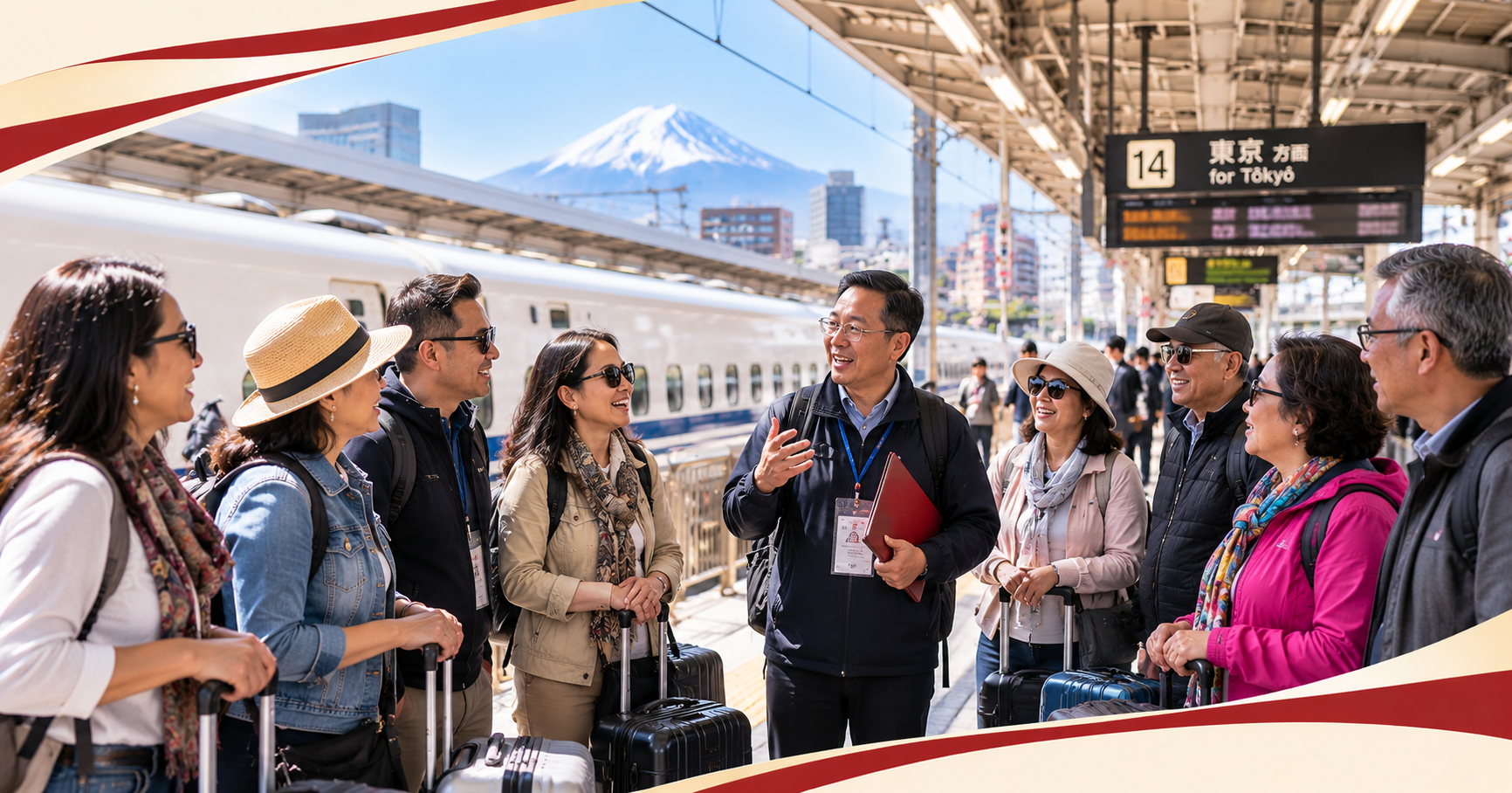
Lots of Japan’s best small restaurants only seat a handful. Walk in as 12 and you’ll likely miss out on the places you most wanted. Book ahead with an exact headcount and keep a plan B nearby.
Language adds to it. The same survey of 4,110 visitors found 15.4% struggled to communicate with staff, second only to the lack of rubbish bins, and restaurants topped the list of places it happened. Outside the main tourist areas, our guides find English menus and English-speaking staff harder to come by.
A bit of admin before you go helps:
Twelve people often means three generations. A pace that suits a 20-year-old can wear out a 75-year-old. By 9pm, it’s usually the other way round.
Ask privately about walking, stairs, sleep and medication.
Leave room to split up. Our itineraries include free days, and your guide can arrange an activity, like a tea ceremony or river cruise, for anyone keen.
Know the ground. Our pace is moderate, but some historic sites have stairs and uneven paths. We can help wheelchair users, though some traditional sites have limits, so talk to us before you book. Prams are fine, with the odd short carry.
Tell us about medical or special needs early so we can sort arrangements in advance.
It’s rarely a disaster. It’s small friction, 12 times a day.
Number five is the one nobody plans for.
Without a guide, the organiser ends up managing Japan. You read the platform signs and count heads at every transfer. You translate the menu, ask about the allergy, find the exit and work out tomorrow while everyone else enjoys today. You’re in Japan. You’re also at work.
With a guide, it’s the same trip minus that load, and you get to experience Japan. Someone else handles the station, so you see your dad’s face when the bullet train pulls in. Someone else orders, so you just eat.
Someone who knows the area takes you to a quieter temple, a seasonal festival or a local restaurant no review site will show you.
The hours a guide saves come out of the holiday itself. Less time on directions, more time in the photos instead of behind the camera.
Would a guide suit your group? Our private charter tours for groups of 8 or more include accommodation, private transport and an English-speaking guide on every tour, and our guide to whether a private Japan tour is worth it runs the per-group numbers. We’re Australian owned and operated. Call 1800 955 822, or send us your group size and dates.
Here’s what comes off your plate on our tours, taken from our published itineraries and FAQ.
| Task | Who usually ends up doing it | What’s taken care of on our tours |
|---|---|---|
| Airport to first hotel | You, with a map app and 24 bags. | A guide meets you at the airport and accompanies you to the first hotel by public transport (you pay the fares). The ski tour uses a private van instead. |
| Hotels in every city | You, comparing booking sites. | We book all accommodation: central hotels with private ensuites, rated at least 3 stars. |
| Daily routes and transfers | You. | A set itinerary for each touring day, with private transport and your guide. Free days are unguided. |
| Luggage between stops | You, hauling 24 cases. | Bags travel with your private coach on touring days. On bullet-train day, they travel with you. |
| Bullet train tickets | You. | Included from Tokyo to Osaka on the 7-day tours, and from Hiroshima to Osaka on the 16-day tour. |
| Lunch for 12 | You, at the door of a full restaurant. | Lunch at a local restaurant on most touring days. Drinks are extra. |
| Allergies and dietary needs | You, translating at the counter. | Where possible, we accommodate vegan and vegetarian diets and most allergies with advance notice. |
| Dinner ideas | You, every night. | Dinner is your choice on most days, but you can ask your guide for recommendations. |
| Attraction tickets | You. | We cover entry fees for attractions included in the itinerary. |
| Someone running late | You, pacing the lobby. | Your guide will assist, although delays may affect the day’s schedule. |
| Free-day plans | You. | Ask your guide to arrange an activity, such as a tea ceremony or river cruise. |
A guide, not a rule. Peak seasons may need more lead time.
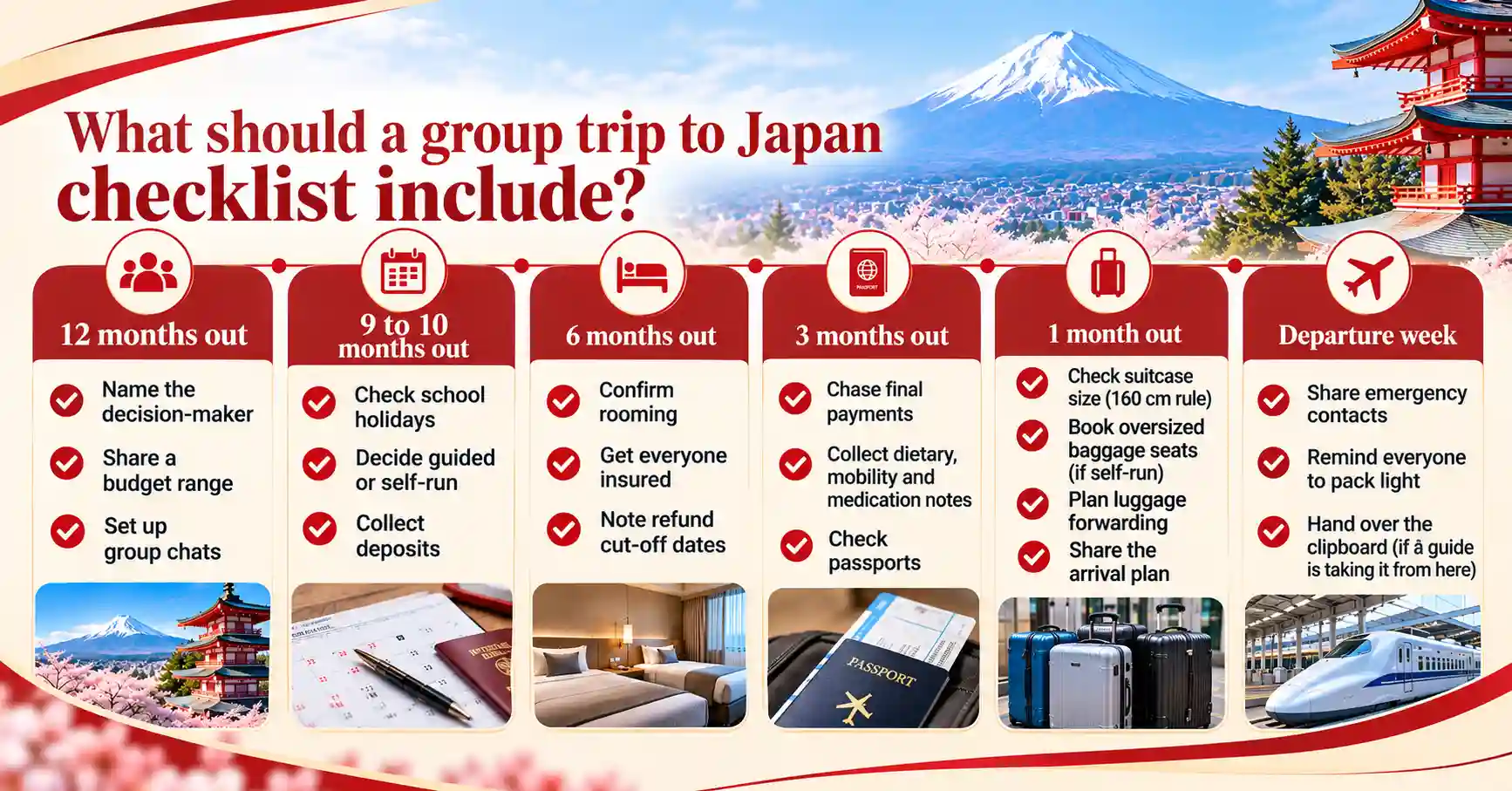
You started this to get your people to Japan together. Make the big calls, sort the money, lock the dates. Then decide who carries the rest. See what a fully arranged week looks like in our upcoming group tours.
Our private tours are designed for groups of 8 or more. Smaller groups can still book, but we price on 8 people. Every tour includes accommodation, private transport and an English-speaking guide, and once you book, the guide and transport are yours alone, with no other travellers joining.
Yes. After the first part payment, the organiser forwards the confirmation email to the group, and each traveller pays their share through its secure link. The booking confirms once the full amount arrives, generally two months after the deposit. We accept credit card and bank transfer, so each member can pay separately.
Usually, if the cases are airline size. Bags up to 160 cm in total go on the racks with no booking. Bags over 160 cm need a reserved seat with an oversized baggage area, and five back-row passengers share each area. Twelve people with extra-large cases need back rows in at least three cars, so send those ahead.
Send them ahead. Japan’s Hands-Free Travel services deliver luggage from Narita, Haneda and Kansai airports to your hotel, and most major hotels can forward bags to the next one. Size and weight limits apply, often around 160 cm and 25 to 30 kg per item. The group then travels between cities with day bags only.
As early as you can, especially for cherry blossom season, school holidays and ski season, when flights and hotels fill first. Allow extra time to line up school holidays across states. Shinkansen reserved seats, including oversized-baggage seats, open one month before travel, so self-run groups should book them the day they open.
On our tours, your guide will assist the late traveller, but delays may affect the day’s schedule. Agree as a group, before you fly, how long everyone waits at a meeting point. A handy trick: give the group a meeting time ten minutes before the real one.